30 September is World Maritime Day. October is South Africa’s National Marine Month. This period is used to create awareness of marine and coastal environments and the benefits that our oceans bring to our nations.
The publishing of this Q&A with Zandile Ndhlovu (aka Zandithemermaid) couldn’t have come at a better time. As the world will be celebrating and appreciating the beauty, diversity and importance of the oceans, we dive in and discover the spectacular life of a lady that spends most of her time diving in the most amazing places with magnificent, breathtaking views.
FS :You are the first black freediving instructor in SA when did that achievement happen?
ZN: I qualified in January 2020
FS: Please give us a brief bio of yourself and intro to Black Mermaid.
ZN: name is Zandile Ndhlovu, I wear a few hats but perhaps we start here, I am a Freediving Instructor, Scuba Diver, Spearfisher woman and surfer, in my time in the water I have also become a digital content creator and am now an emerging film maker, having been selected as 1 of 10 African women to be a part of The Nature Environment and Wildlife Filmmakers Decade Divemaster lab where we learnt about story-telling and underwater cinematography, to which I am now a fellow. I have recently been accepted as a Jackson Wild Fellow, a wildlife film making organization based in the United States and am so excited for this work!
Prior to the water, I worked in Diversity and Inclusion, and so still use this skill set in my advocacy for Diverse Representation in the Ocean arena.
FS: What is free diving and how did you end up as a freediver?
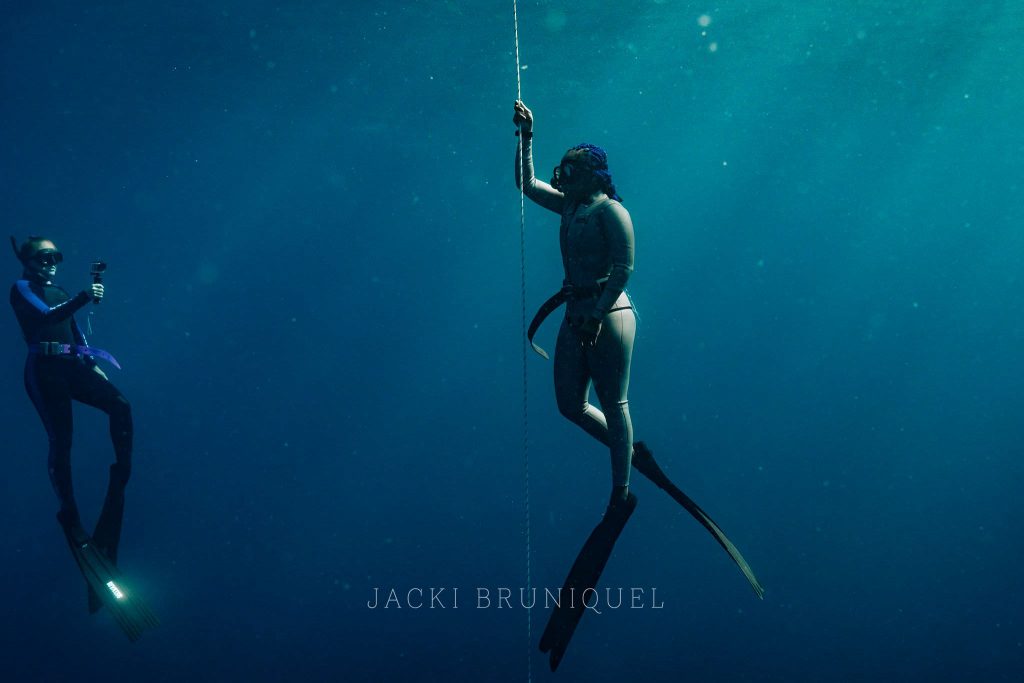
ZN: Freediving is when you hold your breath and dive to depth or even cover distance, it is different to Scuba diving in that, in scuba diving you have air that you use in your underwater exploration, in freediving, you are exploring on one breath, the breath in your lungs!
How I ended up as a freediver started on a trip to Bali in 2016 where I went on my first ever Snorkel trip, I absolutely fell in love with the water and felt a sense of belonging like I had never felt before, I then journeyed through Scuba Diving and later found a video of girls diving without tanks on Instagram, when I discovered this was freediving, I knew I wanted to do it, and from that first dive, I knew I was home, this is exactly what I had been seeking since that day in 2016!
FS: When did you start swimming and How long have you been free diving?
ZN: I’ve never really been a swimmer, I taught myself how to swim probably later in life through gym etc but before then was shallow pools until in grade 6 when I had my drowning incident, perhaps this is when the work towards learning to swim started. I have been Freediving for about 2 years now.
FS: How do you keep your body functioning optimally for your dives ?
ZN: works best is to have a light breakfast before dives, as you don’t want your system to be digesting a heavy breakfast while diving as this will eat into your Oxygen consumption by the body, but you also want to have enough energy for 2—3 hours of work in the water which can be taxing.
Other than this, for me, a plant based diet works beautifully as it keeps me feeling healthy and connected to my body so on every dive, the body feels ready and able, and that’s not to say you have to be plant based to dive, my body works best on this.


FS: What do you enjoy the most when free diving
ZN:The feeling of being weightless and present, there’s the beautiful admiration of the body’s ability to explore on one breath and somehow in the discomfort of when the body needs to breathe, and you don’t… there is something sacred here too, learning to be with the body and doing something so different to what we’ve always been taught in adrenalin situations to run, but here, to pause and be with the body, not rush to the top but to be calm and listen to the discomfort… a beautiful place to be that really does heighten the idea of being present.
FS: What are some dangers associated with freediving?
ZN: Shallow water blackouts, this would happen if someone pushes their limits past their body’s ability to handle, but like in all things, its important to learn how to Freedive correctly, and understand the importance of being able to rescue another diver, these are the most important things when it comes to Freediving and why people must attend a course when exploring Freediving, it allows people to enjoy this beautiful world in a safe manner.
FS: What reactions do you get from people when you tell them about what you do as a freediver and the fact that you can hold your breath for 3 minutes and 55 seconds?
ZN: 2 questions I get the most are
- Why I do white people things?
- And if mermaids exist lol?
Those are definitely the most common questions! I love it though because this is a beautiful way for us to expand, but to also see ourselves as Black people, represented in a space that is largely undiverse and typically perceived to be a white space, which is not true, and as for the mermaids, I always say I don’t know, I haven’t seen them yet 🙂
FS: How would you describe your relationship with the ocean?
ZN: Sacred, and spiritual, this is the place I go to think, its where I can be most true, but also most vulnerable, it is definitely home for me in the most important way, allowing me to find comfort while expanding me into the needed discomfort that allows us to grow, which shows up on land too, becoming more resilient and also more present and aware especially in uncomfortable or conflict situations.
FS: For you, is freediving more of a hobby, career, lifestyle?
ZN: It’s definitely all 3, it’s a blessing to be able to say this and do this. I recently had a shoot where I got to dive in beautiful high tide water, I can’t tell you the joy in my heart, to be able to carry this passion and joy in play, work and lifestyle as I dive with friends too, this is the most incredible thing!
FS: Pollution of the environment, oceans in particular, what can you say about that and are you doing anything to deal with that problem?
ZN: We need to become more intentional, more aware, more conscious of our existence as humans and how that affects the natural world. Our awareness will lead us to be more intentional, like using less single use plastic, and finding ways to reduce, reuse and recycle, and then even further, being aware will lead us to speak up for the natural environment, speak up against the drilling of our ocean floors for the insatiable space that humanity can be, and also capitalism, it will lead us to take action and make our voices heard.
We want to keep these oceans intact not only for the beautiful life that lives in them, but also for the generations to come.
I cant imagine waters without beautiful sharks, corals, turtles or even whales, we have work to do, and it starts with us educating ourselves and being intentional, and spreading the word in our social circles about being the change that we want to see in the world. And this can sound overwhelming right? But it starts with getting a reusable water bottle, a reusable coffee mug, saying no to straws, getting reusable cloth bags and as we reduce the need for plastic production, things begin to change, and when petitions go around, perhaps we ask someone who might be more knowledgeable to enlighten us, and we pass this petition on to our social circles.. things we already do, but perhaps with more intention.

For me, it’s all of the above, including encouraging people who eat fish to use apps like WWF SASSI when at restaurants to know what fish species are endangered and so should not be eaten, but also knowing where our fish comes from is a large part of the problem with large scale fishing emptying our oceans while scarring the ocean floors and damaging coral in addition to the by-catch problem.. its many things.
I also bring change through my work at The Black Mermaid Foundation, where I want to see diverse representation in the Ocean arena but also recognize that the youth are going to be the future guardians of these waters, and how we equip them is by helping them to be able to access the ocean to see what lives under there in hope to plant a seed and create the needed connection to hope that, when the time comes, they will speak up too, for the protection of these oceans.
FS: What other activities do you enjoy on and off land?
ZN: I love solo travel, hiking in the mountains and just exploring the natural world and story telling while doing it! I also love food! I love foraging, its so important knowing where your food comes from, this makes the appreciation factor more, and then preparing it from scratch. We live in a world that has become very convenient and I think there are some skills that we can bring back, just in unpacking the journey of gratitude for where our food comes from, perhaps more awareness and intentionality.
FS: How is the uptake of free diving in SA? Are there many blacks getting involved in it?
ZN: Its slow but I think with time there will definitely be more participation in Black and Brown communities, there is lots of history behind Black people and water and I think it’s in seeing the needed representation that it will become more palatable and then explored, I am excited for this whole journey!
FS: What skills/qualities/characteristics should one possess to become a free diver?
ZN: Perhaps the most important thing is learning to relax, to be calm, this is the biggest thing, I teach you how to hold your breath and many people will go from holding for 15 seconds to 2 minutes and even more, its such a beautiful journey to witness! You do however need to be able to swim in order to come on the course.
FS: For those that want to go on free diving expeditions or training do you offer assistance with that?
ZN: Yes I do, people can contact me through my website www.blackmermaid.co.za and we can arrange from there.

FS: Where can one train as a freediver and how long is the training?
ZN: You can train anywhere where there is deeper waters, I qualified in Johannesburg, in a quarry and actually still enjoy diving in quarries.
With regard to training duration, it is person dependant, depending on your comfort in water, you could qualify in 2 days, or it might take longer and this is okay too, this journey is incredibly personal, which is one of the most beautiful things about Freediving, you can’t compare yourself to anyone else, you could never.
FS: What career opportunities are available for a trained freediver
ZN: As a freediving instructor you can teach Freediving, Freediving in and of itself is more of a hobby or sport, but you can also choose to compete which is also another massively exciting world.